Some days I’m surprised to realize that the last time I stood up from my work desk was two hours ago.
Other days, I stare at my schedule and feel dread. But it’s not that I don’t know what I should be doing. Indeed it’s quite the opposite, as I actually blocked my time for work in advance. However, when it comes to actually sitting down and start working, I’d rather do almost anything else.
For years I have been contemplating what separates these two states. Is there a procedure to help me enter the first one on demand?
As you probably suspect, I’ve tried pomodoro, weekly goals, gamifications, etc. Most of them were helpful for a while until they just… stopped working.
The Monkey
If you’ve read that Tim Urban’s famous post, you know about the instant gratification monkey.
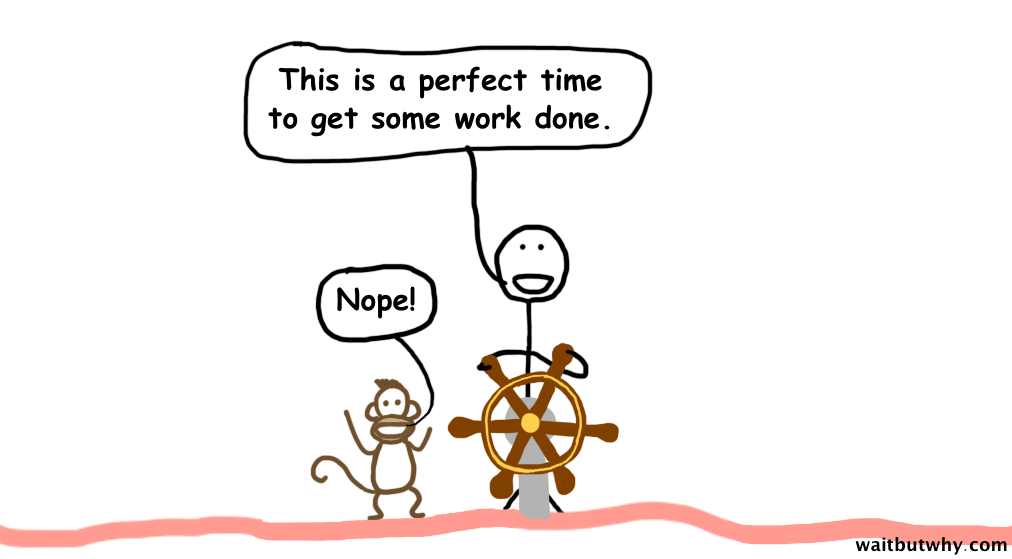
It’s that part of your brain that hijacks control and steers you toward whatever feels good right now. It only sees the immediate: this task requires effort, that YouTube video doesn’t.
The trick isn’t to defeat the monkey, but rather to outsmart it. You need to make starting so easy, so unthreatening, that the monkey doesn’t bother putting up a fight.
First Attempt: Time-Based Goals
My first attempt at taming the monkey was simple: plan and track a weekly time goal—ten hours a week for studying and side projects in a spreadsheet, then try to hit the target.
There’s real merit to this approach. Time spent is a leading metric—you can’t control outcomes, but you can control inputs. Put in enough hours and you already see the win.
For the first two months, I’d check off my hours, feel accomplished, and see genuine progress. The spreadsheet filled up with green cells. I felt proud of myself.
Then month three came with a bit of struggles. For the first time I wasn’t able to keep up with my plan cause, you know, a surprise visit from a close friend. Then came great time together for a few days.
By month four, the whole thing collapsed. Every session started to feel like an obligation. I’d look at my calendar and see “Study ML - 2 hours” and feel dread the same way I feel before a mid-day meeting.
In hindsight I don’t think the problem was discipline. Setting time as the goal made time the enemy.
Instead of asking “what interesting problem should I explore today?”, I was asking “how do I survive the next two hours?”. I was physically present but mentally checked out, waiting for the clock to release me.
Even worse, when I missed a day, the guilt compounded—now I owed the spreadsheet extra hours, the deficit grew, and eventually I just stopped looking at the tracker altogether.
Time-based goals had given me a system, but they’d killed the very thing that makes work sustainable: curiosity.
The Love-Hate Calendar
After my tracking system collapsed, I couldn’t even look at my calendar. The sight of those time blocks triggered guilt.
There’s a small issue: Tracking time is still in my blood. I’ve always been the person who blocks out my week, who wants to see where my hours went. Abandoning that entirely felt like losing a limb. So I kept using Google Calendar—just without the weekly targets. I’d block time for a session, start working, and if I wanted to keep going, I’d drag the end time forward.
That’s when I noticed something. Calendar only lets you snap to 15-minute increments. Every time I extended a session, I was committing to “just 15 more minutes.” But here’s what happened: I’d finish my current task six minutes into that new block — and suddenly I had nine minutes left to fill. That leftover time created a strange pull. Instead of stopping, I’d start on something else just to complete the block. Then I’d drag it again.
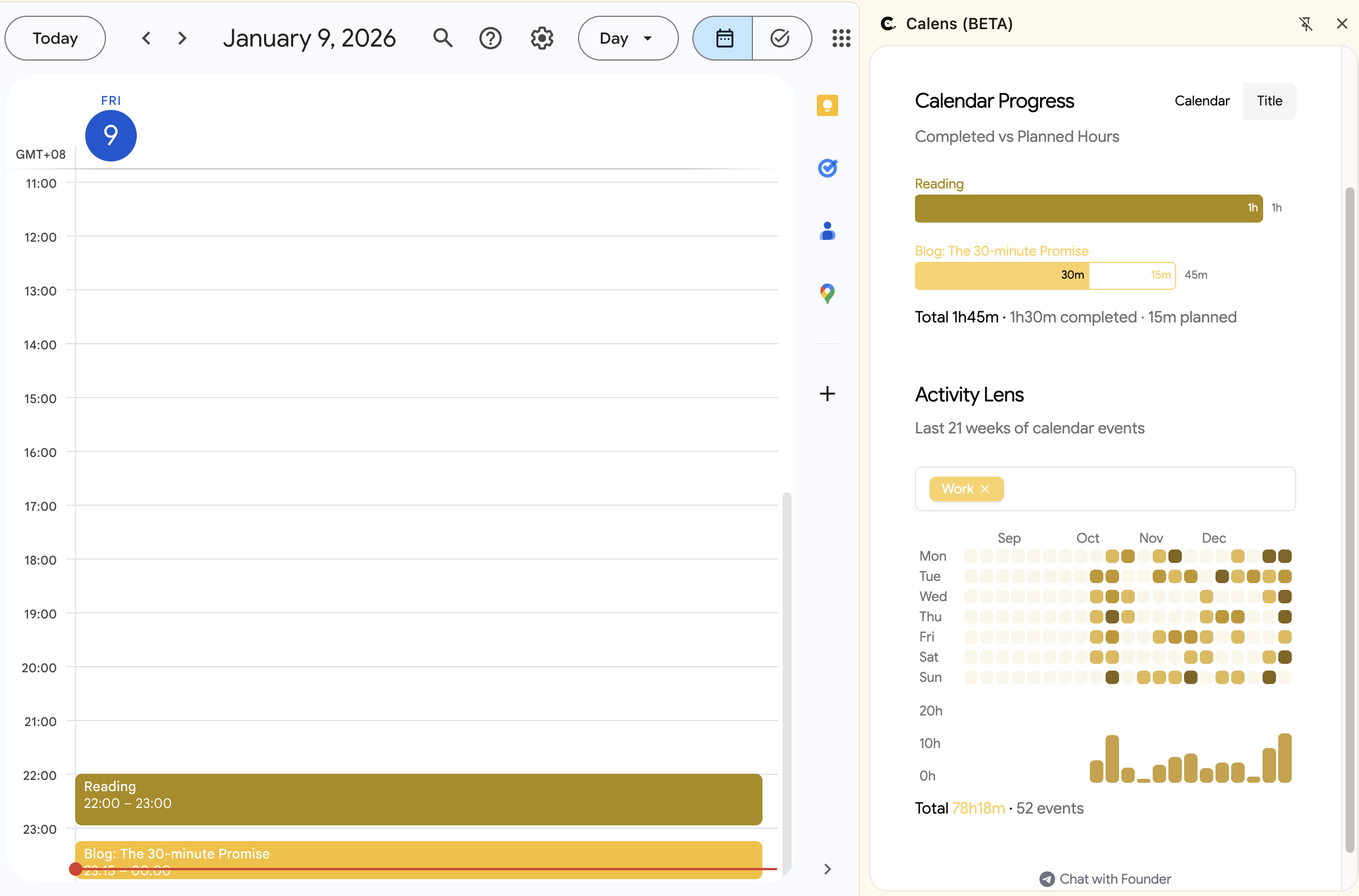
The pattern was obvious once I saw it. Tracking time wasn’t the problem and it shouldn’t be. The monkey had been fighting the idea of advance commitment to long hours, not the work itself. When I stopped measuring myself against the calendar and started using it to help coordinate small commitments, everything changed.
Now I start every session with Calendar open. The same tool I once avoided is now how I trick myself into starting and keep myself going.
The 30-Minute Promise
So I made the commitment explicit: just 30 minutes to start, with real permission to stop. If I want to walk away at minute 31, I can do that without feeling guilty.
Thirty minutes is nothing. It’s one episode of a sitcom. The monkey doesn’t even bother resisting something that small.
That’s the trick though. The promise itself is what disarms the monkey. You’re not lying to yourself about “just getting started”. You genuinely mean it: 30 minutes, then you’re free.
But here’s what actually happens once you sit down.
You pick a specific question to work on—not “study machine learning,” but something concrete like “how would I implement a recommendation system for this dataset?”. You start with the simplest thing possible: typing out your thoughts. That’s it, you start poking at the problem. And somewhere around minute 20, something shifts. You’re not watching the clock anymore. You’re actually curious about the answer.
By minute 30, you’re in the middle of something. Stopping feels harder than continuing. So you extend, and the flywheel kicks in.
Over time, something strange happens: the monkey starts trusting you. When you consistently honor the promise—yes, sometimes you actually do stop early—your brain stops treating “30 minutes” as a lie. The next time you say it, there’s no negotiation.
Also remember that the magic is not about the initial 30 minutes. It’s about what happens after.
Saving Your State
What happens when you have to stop mid-task? That’s fine—just spend two minutes writing down where you are. Anything, even a messy state dump can do.
Here’s what mine looks like mid-project:
- ✅ PoC connect to real user data and display the chart
- ✅ Add debug mode with query date range and events list
- ✅ Move to different week updates the visuals
- ⏳ ⚠️ Content not responsive when side panel shrinks
Notice it’s not either pretty or even clear. The important bit is that the little ⏳ tells future-me exactly where to pick up.
There’s another benefit in this act. The next time you sit down for 30 minutes, you don’t need to figure out what to work on. The questions are already there, waiting to run over your mind. In no time you’re deep into the context.
Everyday Promise
The promise alone has an obvious weakness: without some baseline discipline, it’s easy to skip entirely. The solution is committing to at least one 30-minute session every day.
That daily commitment is your bottom line. It’s the non-negotiable that keeps you in the game even on bad days. Some days you’ll stop at exactly 30 minutes—and that’s fine.
What matters is that you showed up.
Credits
Appreciate Binh, Son and Ha for reviewing the drafts.
If you find this article helpful, please cite this writeup as:
Quy, Dinh. (Jan 2026). The 30-Minute Promise. dvquys.com. https://dvquys.com/posts/the-30m-promise/.